Four earth tones, two glaze finishes and 32 product configurations—from sampling to batch production.
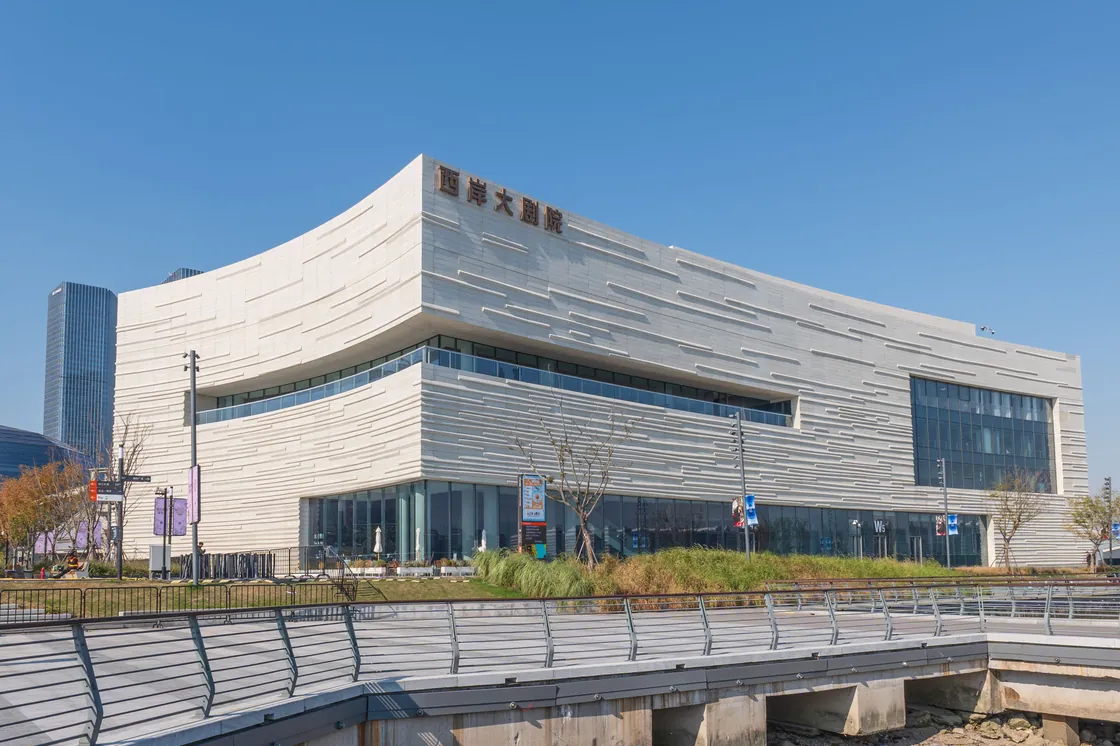
Located on Shanghai’s Xuhui waterfront, West Bund Grand Theatre was designed by Schmidt Hammer Lassen Architects. The project includes a 1,600-seat main auditorium, a 200-seat black box theatre, rehearsal facilities, a public lobby and supporting spaces.
For this project, LOPO China manufactured and supplied terracotta panels and baguettes for the theatre’s public areas and interior wall surfaces, covering approximately 9,056 m². From sample approval through batch production, our role was to translate the specified profiles, dimensions, colors and finishes into interior terracotta cladding products that could be produced consistently and installed on site.
 West Bund Grand Theatre: 9,056 m² of Interior Terracotta Cladding
Project Information
| Item | Details |
|---|---|
| Project | West Bund Grand Theatre |
| Location | Xuhui Waterfront, Shanghai, China |
| Architect | Schmidt Hammer Lassen Architects |
| Client | West Bund Group |
| Gross floor area | Approximately 23,177 m² |
| Programme | 1,600-seat main auditorium, 200-seat black box theatre and supporting public spaces |
| Material supplier | LOPO China |
| Scope of supply | Interior wall terracotta cladding |
| Product types | Integrated profiled terracotta panels with projecting baguette ribs; rectangular terracotta baguettes |
| Product range | 4 profiled panel types and 8 rectangular baguette profiles |
| Colors | Ochre, light yellow, light brown and dark brown |
| LOPO color codes | 236, 238, 770 and 769 |
| Surface finishes | Matte glaze and low-sheen glaze |
| Product configurations | 32 |
| Supply quantity | Approximately 9,056 m² |
| Application areas | Lobby, public corridors, stair areas and theatre-related spaces |
| Supply year | 2024 |
From the Riverfront Exterior to the Theatre Interior
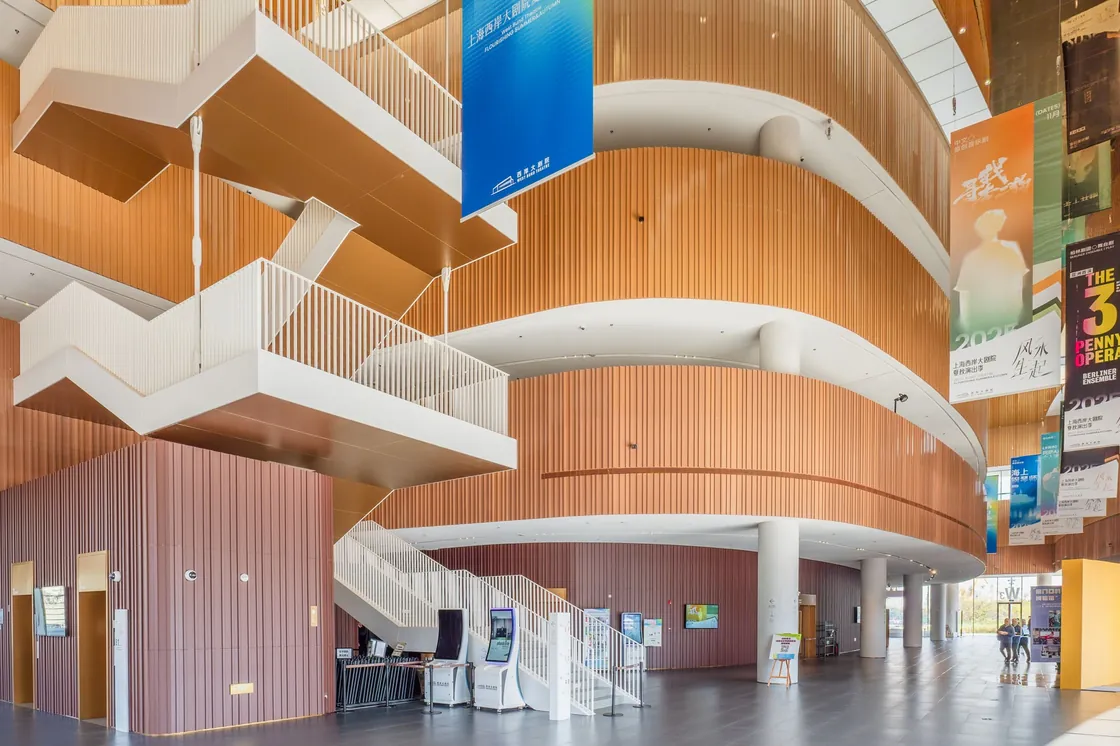
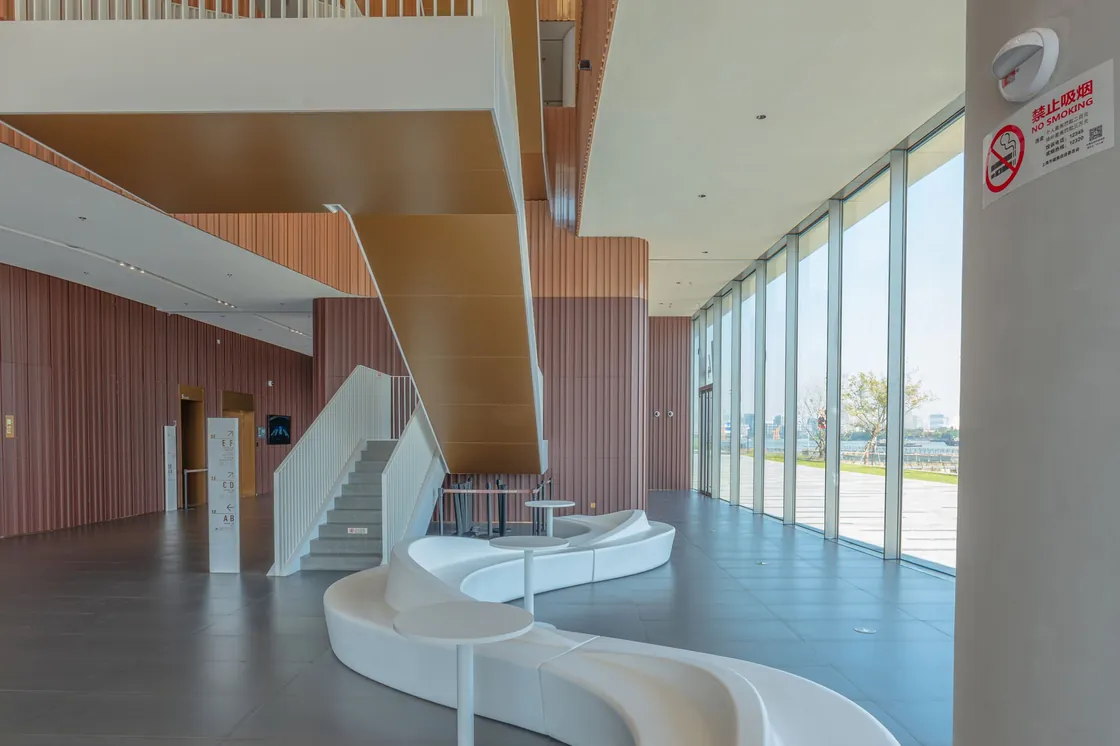
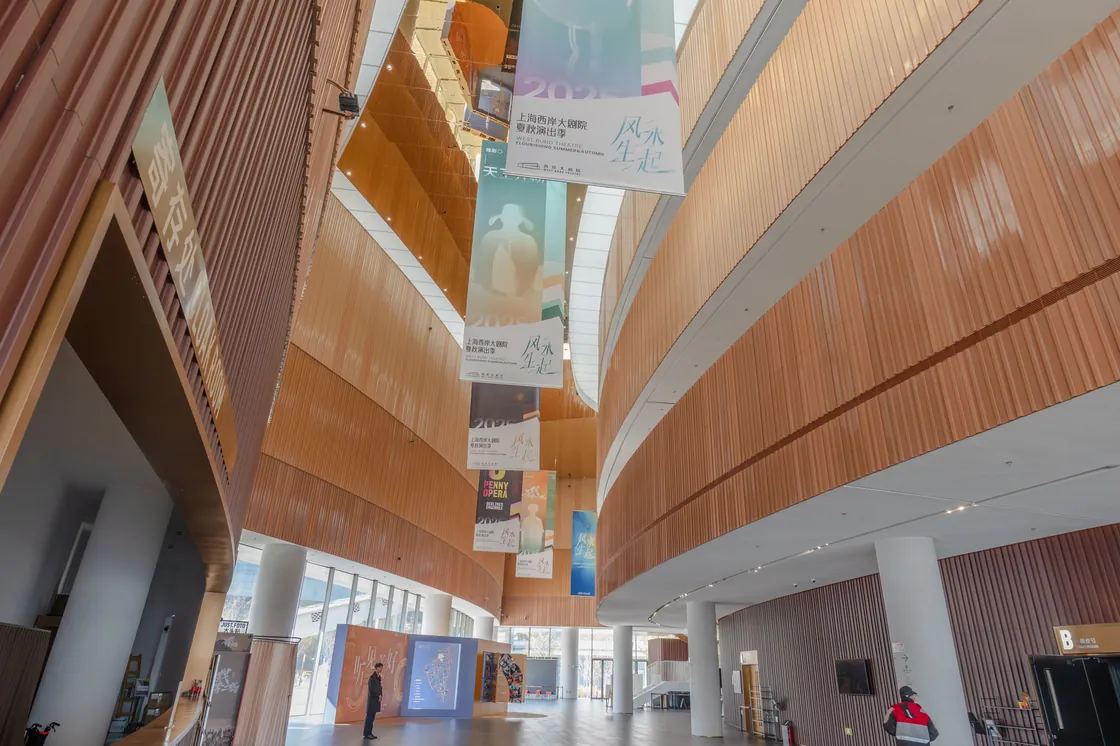
The exterior of West Bund Grand Theatre is monolithic and restrained, reflecting the industrial context of the Xuhui waterfront. Inside, the atmosphere becomes warmer and more open. Skylights, curved surfaces and continuous wall planes shape the sequence of arrival, waiting, intermission and circulation.
The theatre lobby is more than a ticketing and circulation space. Before a performance, it accommodates gathering, waiting and conversation; during intermission, it remains an important part of the overall theatre experience. In a public interior of this scale, the wall finish needs to maintain architectural order without making the space feel cold or overly reflective.
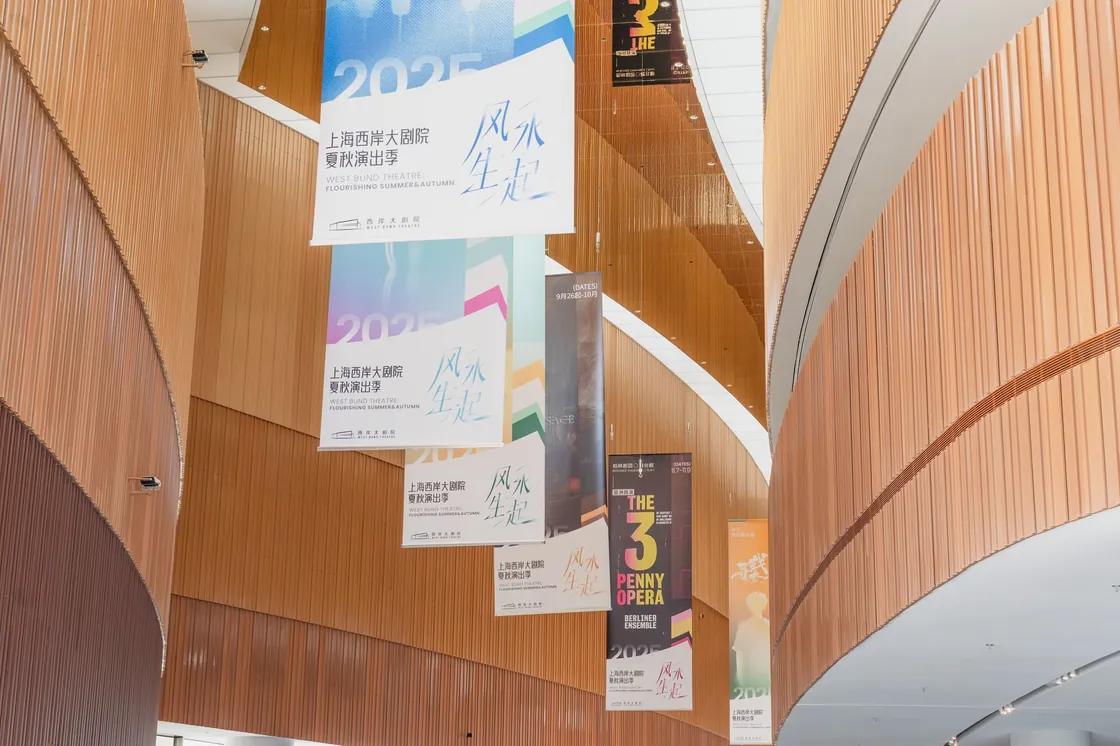
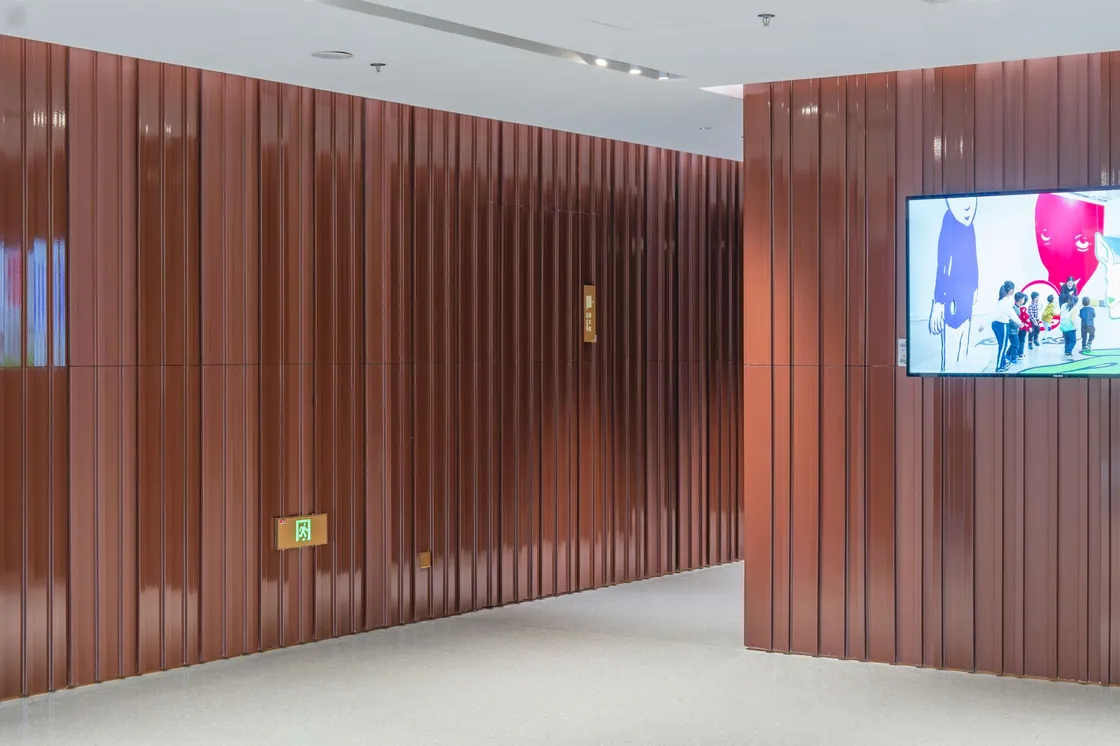
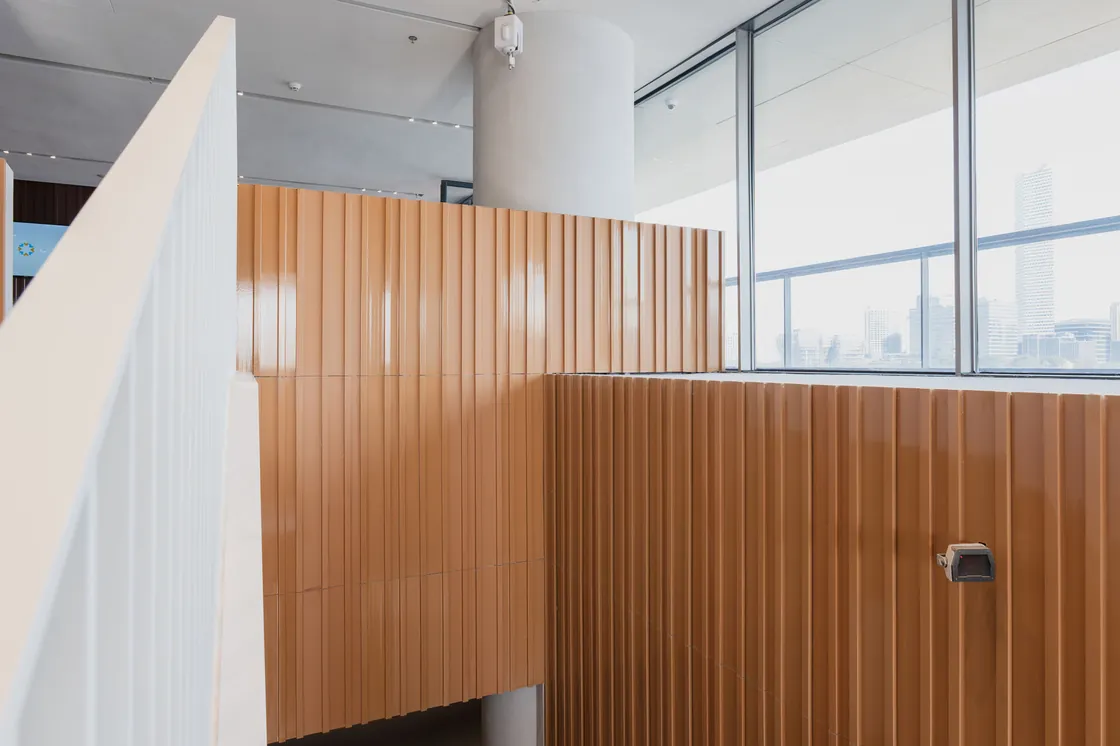
The terracotta cladding uses four warm earth tones, each developed in matte and low-sheen glazed finishes. Under daylight and artificial lighting, the two finishes create subtle differences in brightness, giving the continuous wall surfaces a calm and softly modulated appearance.
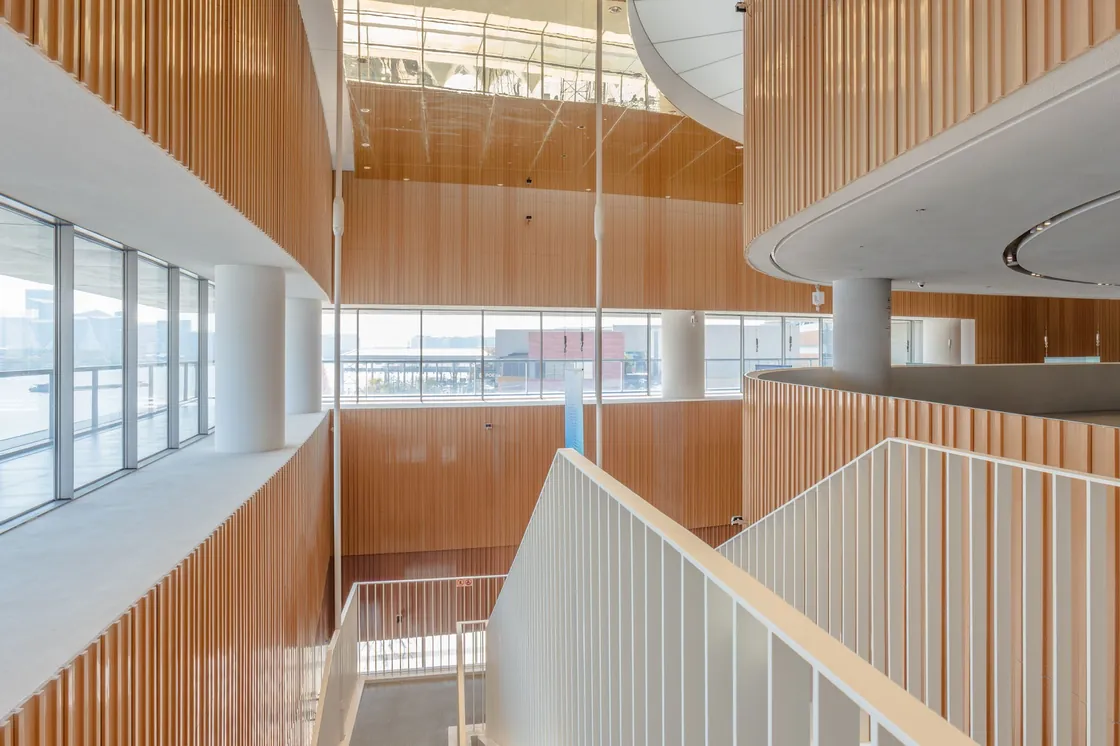
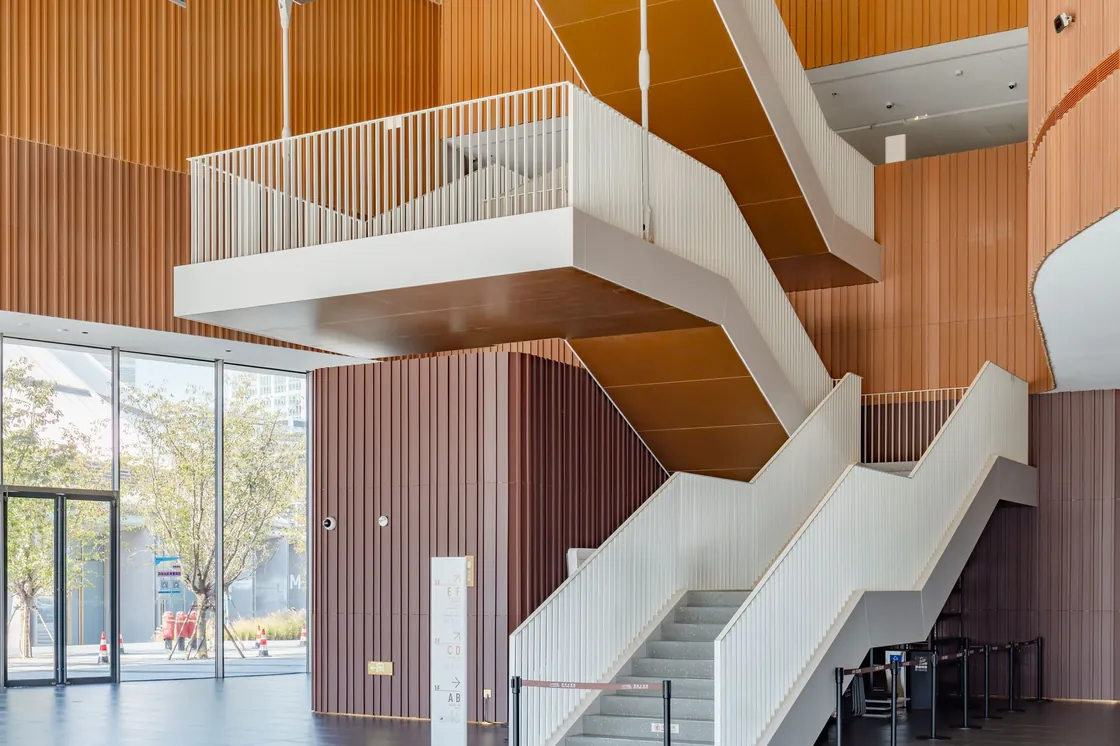
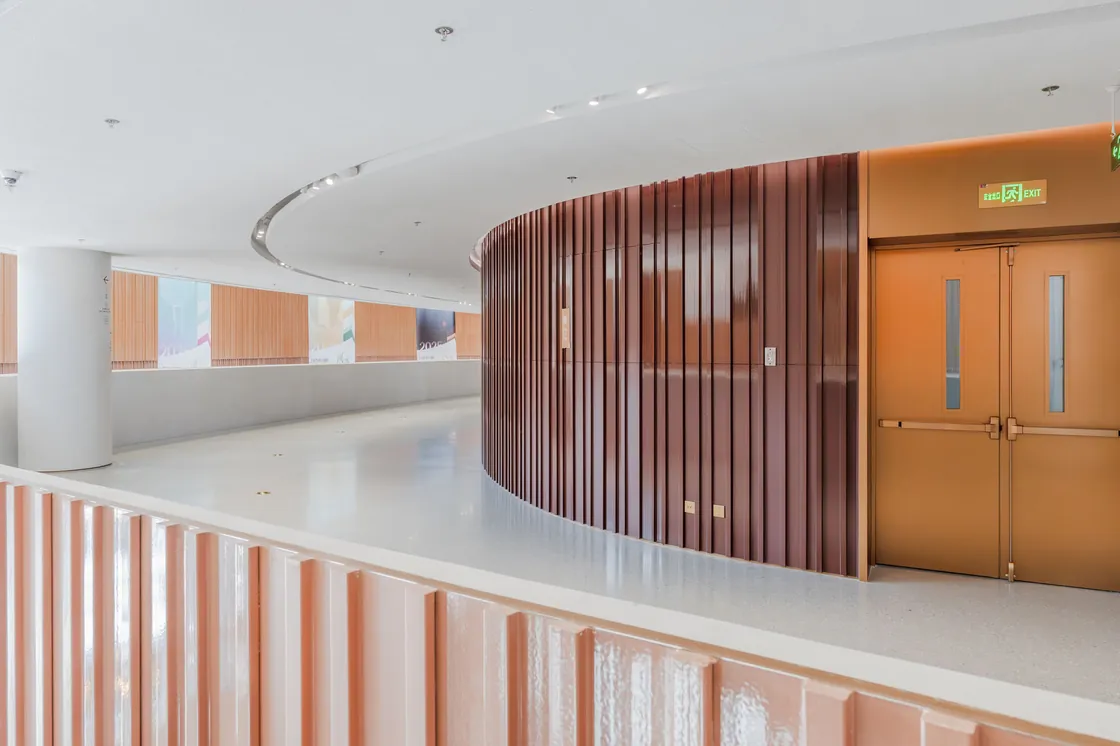
The walls use integrated profiled terracotta panels with projecting baguette-like ribs. The broad panel face and the projecting rib are formed as a single extruded terracotta unit rather than assembled from separate components. The profiled panels are installed in an overlapping arrangement, while rectangular terracotta baguettes are combined with the panels in selected areas.
From a distance, the projecting vertical ribs, panel modules and joints establish a regular rhythm. At close range, the differences in glaze, color and fired terracotta surface become more apparent.
Although the lobby, public corridors and theatre-related spaces use different profiles, the four earth tones and the recurring vertical forms remain consistent. As visitors move from the entrance through the lobby and into the circulation areas, the color and vertical rhythm of the wall surfaces continue without an abrupt visual break.
From Public Areas into the Theatre Interior
According to publicly available project information, the main auditorium uses custom sand-colored acoustic terracotta panels, while the lobby uses related terracotta wall finishes. Their similar color palette and material character create a visual connection between the public areas and the main performance spaces.
For this project, LOPO China’s glazed profiled terracotta panels were used primarily in the lobby, public circulation areas and theatre interior walls. Rectangular terracotta baguettes were combined with the profiled panels in theatre-related areas according to the design requirements.
The lobby and public circulation areas rely mainly on integrated profiled panels, while rectangular baguettes of different cross-sections are introduced in selected theatre spaces. Although the profiles and combinations vary, the use of related earth tones and vertical elements keeps the wall surfaces visually consistent across the different areas.
Why Terracotta Works in These Public Interiors
The lobby, corridors and theatre-related spaces experience concentrated visitor traffic before and after performances. Wall materials must withstand frequent contact, regular cleaning, close-range viewing and the effects of long-term operation. Fired terracotta provides a stable material and surface finish suited to public interiors where the completed appearance needs to be maintained over time.
The project avoids large areas of high-gloss finish. Instead, matte and low-sheen glazes moderate surface reflectivity. The integrated profiled panels and rectangular baguettes create vertical shadows across the wall surfaces, with the visual depth coming from the profiles, glaze variations and joint relationships rather than from applied patterns or decoration.
The project’s 12 base profiles were assigned different lengths, colors and glaze finishes according to their application areas, resulting in 32 product configurations across approximately 9,056 m² of interior wall surfaces. Once the samples were approved, production control focused on the dimensional, cross-sectional, color and glaze consistency of each configuration.
From Sample Approval to Batch Production
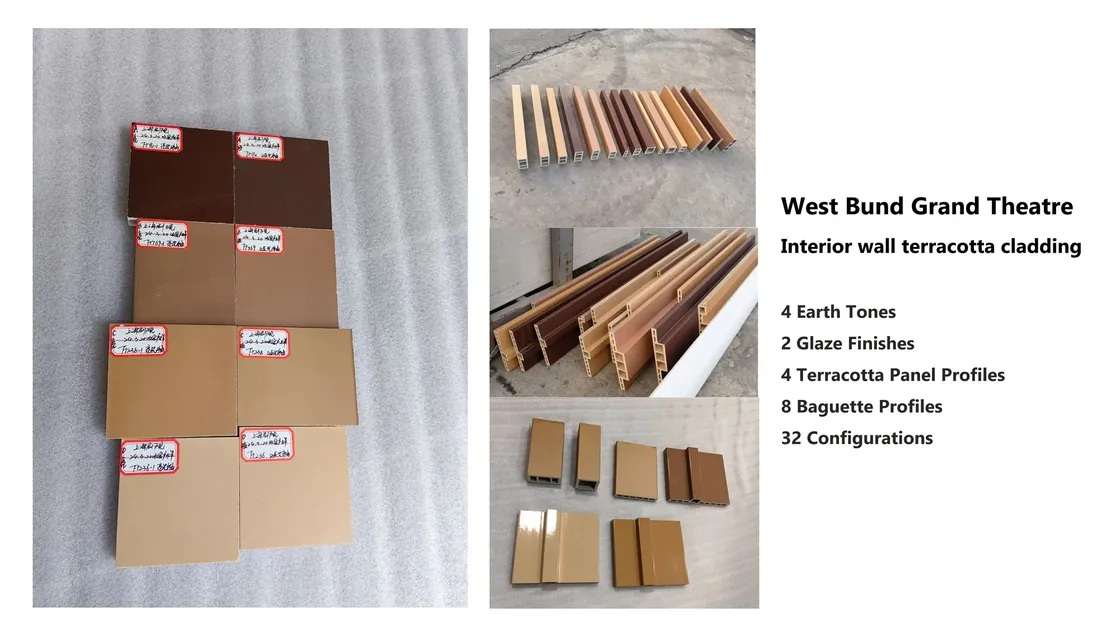
The interior terracotta cladding package covered approximately 9,056 m² and included 4 profiled terracotta panel types, 8 rectangular baguette profiles, 4 earth tones and 2 glaze finishes. Not every profile was produced in every color and finish. The combinations were assigned according to specific application areas, resulting in 32 product configurations.
Unlike a large order based on one repetitive product, this project involved relatively limited quantities of individual configurations but a broad range of profiles, lengths, colors and glaze combinations. Production therefore required clear identification of each product configuration and close coordination between production scheduling, dimensional inspection, color management and batch control.
Profile and Dimensional Control
The design uses four integrated profiled terracotta panels. Each unit is extruded as a single piece, with a broad panel face and a projecting vertical baguette-like rib formed within the same cross-section. Once installed in an overlapping arrangement, the panels create a continuous vertical relief across the wall.
Eight rectangular terracotta baguette profiles are used alongside the profiled panels to adjust the scale and vertical rhythm of different wall areas.
| Product | Number of profiles | Cross-section dimensions (mm) | Length range (mm) | Colors | Surface finishes |
|---|---|---|---|---|---|
| Integrated profiled terracotta panel | 4 | 230 × 47; 200 × 47; 315 × 60; 320 × 60 | 1,100–1,757 | Ochre, light yellow, light brown and dark brown | Matte glaze and low-sheen glaze |
| Rectangular terracotta baguette | 8 | 70 × 25; 150 × 25; 75 × 50; 100 × 50; 75 × 70; 150 × 100; 150 × 80; 150 × 50 | 1,100–1,757 | Ochre, light yellow, light brown and dark brown | Matte glaze and low-sheen glaze |
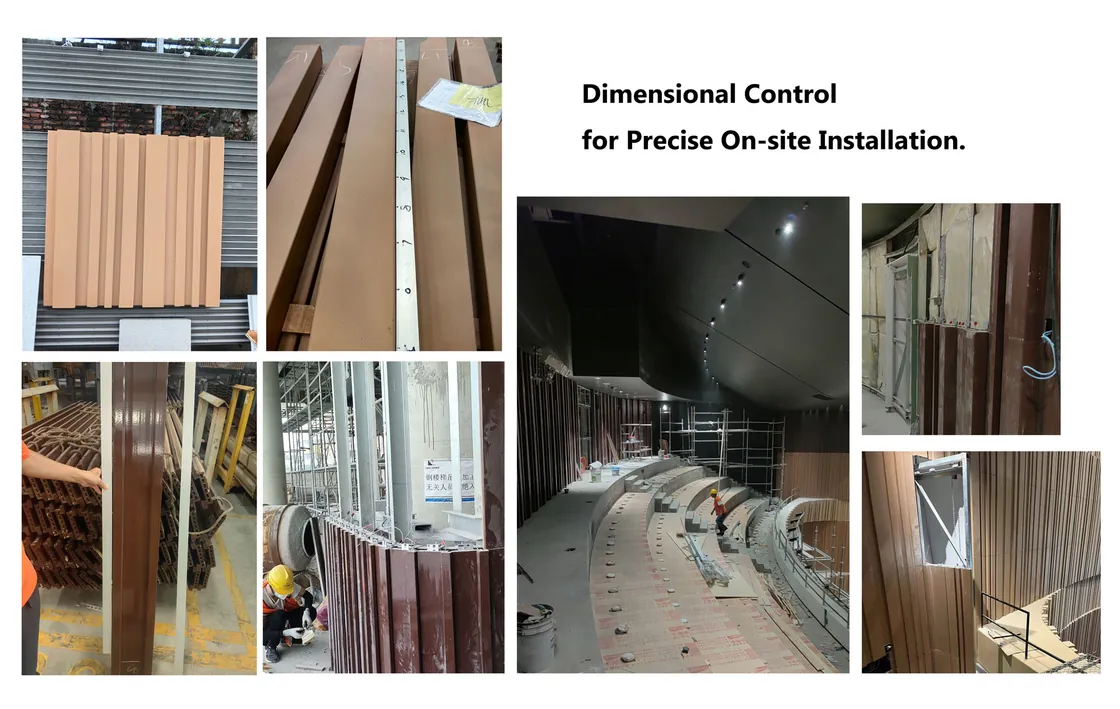
Across a large continuous wall, small dimensional deviations can accumulate as installation progresses. This is especially important where profiled panels overlap: variations in width, thickness or cross-section affect not only individual units, but also joint widths, the alignment of vertical lines and the relationship between adjacent components.
In addition to checking the length, width, thickness and cross-section of individual products, LOPO China controlled consistency between production batches of the same profile. This helped reduce variations in joint width, misalignment of vertical elements and localized unevenness after installation.
Color and Glaze Control
Interior terracotta is viewed at close range. Differences in color, local sheen and glaze condition are therefore more noticeable than on façade products seen from a distance. The theatre’s public spaces are also exposed to daylight, artificial lighting and localized shadows, meaning the same color can appear different depending on its position.
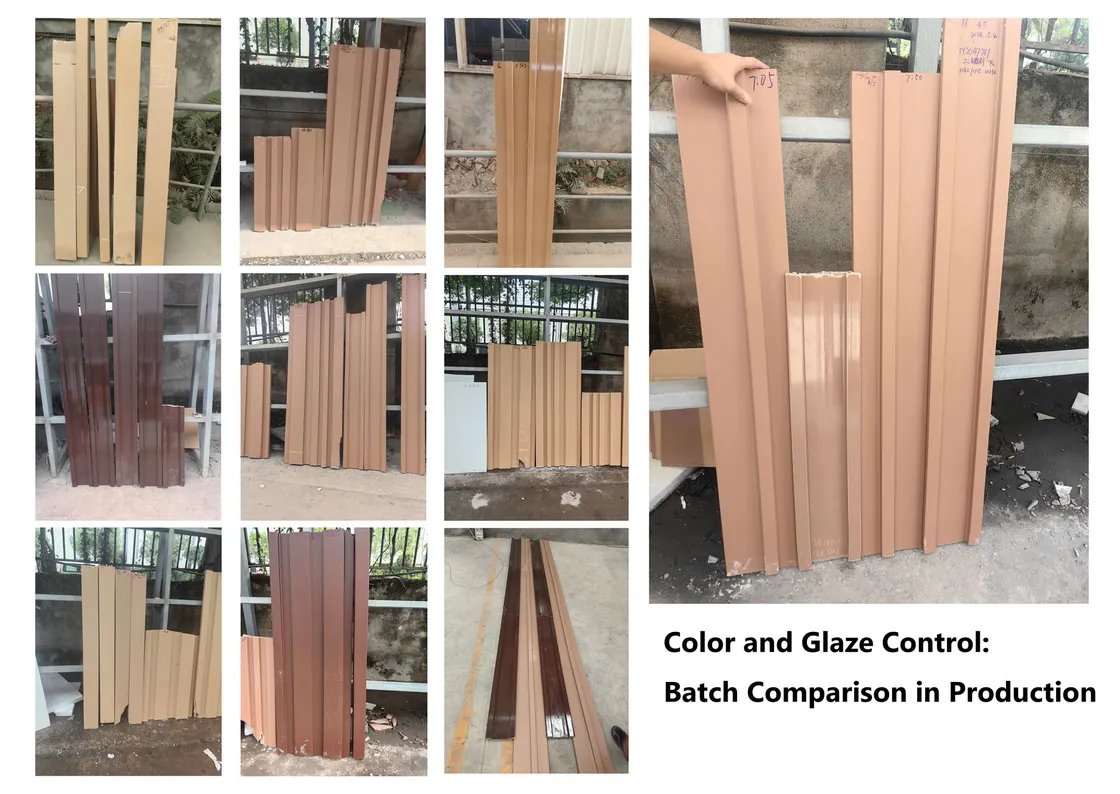
To establish the relationship between the warm terracotta colors and the interior lighting, the project went through initial samples, revised samples and large-format sample approvals. The final selection consisted of four warm earth tones—ochre, light yellow, light brown and dark brown—and two glaze finishes: matte and low sheen.
During batch production, the colors and glaze finishes were compared against the approved samples. Products were graded where necessary according to their fired color, while raw-material preparation and firing control were adjusted in response to actual kiln results. The objective was to keep each batch within the approved range of color and surface appearance.
Natural variations in fired color are part of the character of terracotta. Color management was not intended to remove all variation, but to prevent abrupt differences between adjacent units and to maintain overall coordination across the four colors and two glaze finishes.
For a project involving 32 product configurations, color management also had to remain linked to profile and application area. The same color code can read differently on different profiles, under different glaze finishes or in different lighting conditions. Color approval therefore could not rely on small color samples alone.
A Note on Theatre Acoustics
Interior wall surfaces in theatres, concert halls and opera houses serve a visual function and may also form part of the overall acoustic environment. As a hard material, terracotta can provide a reflective surface. When profile geometry, surface relief, joints, backing cavities or absorptive assemblies are incorporated into the overall design, terracotta can also form part of the acoustic strategy developed by the project team.
The acoustic performance of a space is not determined by an individual terracotta panel. It depends on the building geometry, material location, wall construction, backing system and the overall acoustic design.
LOPO China did not undertake the acoustic research, calculations or performance assessment for West Bund Grand Theatre. Our scope was to manufacture the terracotta panels and baguettes in accordance with the approved technical documents, controlling their profiles, dimensions, colors, glaze finishes and batch quality so that the products met the requirements of the interior wall system.
Project Note and Copyright
This case study is based primarily on LOPO China’s project supply records, including product dimensions, quantities, colors, profiles, glaze finishes and production information. General project information is referenced from publicly available sources.
Unless otherwise stated, all text, images and project documentation on this page are the property of LOPO China / lopochina.com. Unauthorized reproduction or commercial use is prohibited.